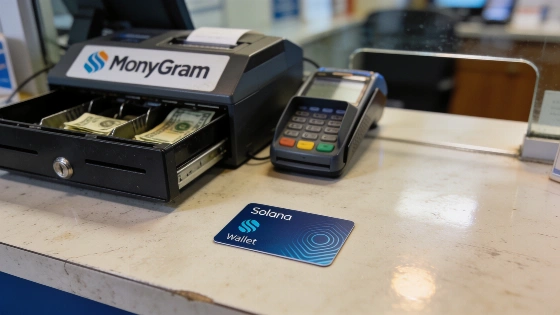
MoneyGram has integrated its Ramps service with Solana, enabling users in over 170 countries to withdraw cash from supported wallets and allowing cash deposits in more than 25 countries through its global network.
MoneyGram has launched its Ramps service on the Solana blockchain, opening up new cash access options for users and developers across more than 170 countries and territories. The integration allows Solana-based wallets, exchanges, and applications to connect directly to MoneyGram's global payment infrastructure, streamlining the process of converting between digital assets and local currency. According to CoinMarketCap, this move is designed to lower the barriers that have historically slowed crypto adoption in regions with limited banking access or complex regulatory requirements.
How MoneyGram Ramps Works
For end users, the process is straightforward. Anyone holding digital assets in a supported Solana wallet can visit a MoneyGram location and withdraw local currency, or deposit cash to receive digital assets in their wallet. Cash deposits are currently available in more than 25 countries, while withdrawals are supported in over 170 countries and territories-covering much of MoneyGram's existing retail footprint. This approach removes the need for individual crypto developers to negotiate separate banking or cash-outlet agreements, as MoneyGram handles regulatory approvals and physical outlet partnerships on their behalf.
Implications for Developers and Emerging Markets
By integrating with Solana, MoneyGram aims to make it easier for developers to offer fiat on-ramps and off-ramps without building their own compliance and banking infrastructure. This is particularly relevant in emerging markets, where setting up cash access points can involve complex regulatory hurdles and significant operational costs. With Ramps, developers can focus on building user-facing products while relying on MoneyGram's established network for cash transactions. The company reports serving around 60 million active customers globally through its retail locations.
Multi-Chain Strategy and Stablecoin Expansion
MoneyGram's Solana launch is part of a broader multi-chain strategy that began in 2022 with a partnership with the Stellar Development Foundation. That collaboration enabled users to convert between cash and USD Coin (USDC) at MoneyGram locations. In June 2026, MoneyGram announced MGUSD, a dollar-backed stablecoin issued by Bridge, a Stripe-owned infrastructure firm, on the Stellar network. The company also became a validator on Solana and joined Open USD, a Stripe-led initiative to share stablecoin revenue among participating firms. These moves reflect a growing trend among payment companies to use dollar-pegged tokens for cross-border transfers, offering an alternative to traditional correspondent banking networks.
As of June 2026, MoneyGram's global network supports cash withdrawals in over 170 countries and territories, with cash deposit functionality live in more than 25 countries. The company's retail footprint serves approximately 60 million active customers, according to its public disclosures. Solana, the blockchain now integrated with MoneyGram Ramps, has consistently ranked among the top five blockchains by daily transaction volume, with over 20 million active addresses reported in the first half of 2026, based on data from Solana Foundation.
Integrating cash on-ramps and off-ramps with blockchain networks like Solana highlights the ongoing challenge of bridging digital assets with traditional financial systems. While blockchain technology can enable fast, low-cost transfers, access to local currency remains a critical barrier for many users, especially in regions with limited banking infrastructure. Services like MoneyGram Ramps aim to address this gap, but their effectiveness depends on regulatory compliance, network reliability, and the willingness of users to trust both the blockchain and the intermediary handling cash transactions. As stablecoins and blockchain-based payment rails continue to evolve, the interplay between digital and physical finance will remain a central issue for global crypto adoption.