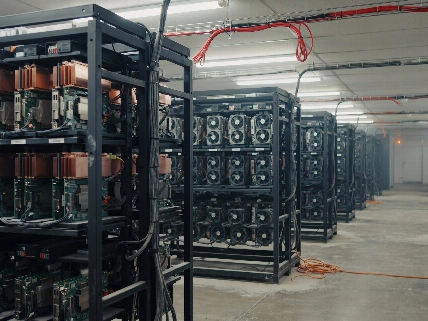
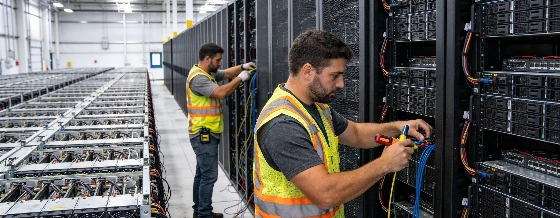
Core Scientific's Q2 results show a sharp contrast between its struggling Bitcoin mining operations and the profitability of its AI data center business, raising questions about the future of large-scale crypto mining in the U.S.
Core Scientific, once one of the largest Bitcoin mining companies in North America, is rapidly shifting its business model as the economics of self-mining deteriorate. In its latest quarterly report, the company revealed a negative 56% gross margin for Bitcoin self-mining in the second quarter of the year, with $21.5 million in mining revenue dwarfed by $33.7 million in direct costs. The result was a $12.2 million gross loss for the segment, driven by high power fees, depreciation, and other operational expenses. This performance underscores the mounting challenges facing industrial-scale Bitcoin miners as energy costs rise and block rewards decline.
In stark contrast, Core Scientific's high-density colocation business-where it provides data center capacity for artificial intelligence (AI) clients-generated $136.7 million in revenue and $80 million in gross profit, representing a 59% margin. Notably, this segment's gross profit exceeded the company's consolidated total, as losses from mining and other operations pulled down overall results. The company's Q2 net loss of $1.16 billion was primarily attributed to a $1.05 billion non-cash expense related to warrants and contingent value rights, triggered by a rise in its stock price, rather than ongoing operational losses.
Mining Wind-Down
According to the company's earnings call, Core Scientific is now operating Bitcoin mining primarily to offset contractual power costs during the transition. By the end of June, the company had nearly 30% fewer mining machines online compared to the previous quarter and was self-mining at only two sites. The company has not disclosed the exact mining capacity remaining or provided a detailed timeline for the full conversion of its facilities to AI hosting.
Core Scientific reported 395 megawatts (MW) of billing colocation capacity at the end of Q2, increasing to 437 MW by mid-July. The company estimates that this footprint could generate approximately $635 million in average annualized colocation revenue under generally accepted accounting principles (GAAP). However, this remains well below the 1.1 gigawatts of leased customer power capacity tied to more than $24 billion in potential contracted revenue, much of it anchored by long-term agreements with AMD covering about 530 MW across five sites.
AI Hosting Outpaces Mining
The company's pivot to AI infrastructure is not unique among large-scale miners, but the scale of Core Scientific's transition is notable. The firm says it is repurposing its remaining mining facilities for high-density colocation "as circumstances allow," but has not declared the shift compulsory or identified a specific quarter as the trigger. The gap between current operational capacity and the company's long-term contracted potential highlights the work still required to fully realize its AI ambitions.
For U.S. investors and crypto market participants, Core Scientific's results illustrate the growing divergence between traditional Bitcoin mining and emerging demand for AI data center infrastructure. As mining profitability is squeezed by rising energy costs and halving events, some operators are seeking more stable and lucrative revenue streams by converting their facilities to serve the booming AI sector. The company's experience may serve as a bellwether for other miners facing similar economic pressures.
Key Figures and Market Context
During the second quarter, Core Scientific's self-mining segment generated $21.5 million in revenue against $33.7 million in costs, resulting in a $12.2 million gross loss. The high-density colocation segment, by contrast, produced $136.7 million in revenue and $80 million in gross profit. At quarter-end, the company reported 395 MW of billing colocation capacity, rising to 437 MW by mid-July. The company's net loss of $1.16 billion for the quarter was largely due to a $1.05 billion non-cash fair-value expense related to warrants and contingent value rights.
Bitcoin mining economics are shaped by a combination of network difficulty, block rewards, token price, and operational costs-especially electricity. As block rewards halve roughly every four years, miners must either improve efficiency, secure cheaper power, or diversify revenue streams to remain viable. The rise of AI and high-performance computing has created new demand for data center infrastructure, offering an alternative path for companies with large-scale facilities and access to reliable power. For miners, the decision to pivot is often driven by local energy markets, contract terms, and the pace of AI adoption, making the transition complex and highly dependent on individual circumstances.