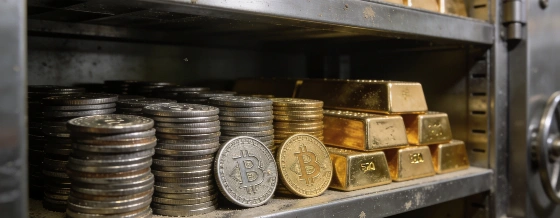
Binance co-founder Changpeng Zhao believes Bitcoin could surpass gold's market value in the next bull run, but warns that government adoption as a reserve asset will take years due to entrenched infrastructure and regulatory inertia
Changpeng Zhao, the co-founder and former CEO of Binance, told attendees at the Bitcoin Asia 2026 conference in Hong Kong that he expects Bitcoin's market value could overtake gold's as soon as the next major bull cycle. While gold's market capitalization remains roughly ten times larger than Bitcoin's, Zhao argued that the gap may narrow rapidly as more investors and institutions treat Bitcoin as a digital reserve asset. He described Bitcoin as structurally superior to gold for reserve purposes, citing its portability, divisibility, and verifiable scarcity.
Institutional and Government Adoption
Zhao acknowledged that while private investors may shift toward Bitcoin relatively quickly, sovereign adoption will be much slower. Most governments have built extensive infrastructure for valuing, storing, and trading gold, and replacing these systems with Bitcoin-based reserves would require years of policy, technical, and operational changes. Zhao suggested that governments considering crypto reserves should focus on the largest non-stablecoin cryptocurrencies, weighted by market capitalization-a model that would currently allocate about half to Bitcoin, with the remainder split among Ethereum, BNB, and others. He noted that this approach is not without conflicts of interest, given his role in the creation of BNB.
AI and Crypto Integration
Beyond reserve assets, Zhao discussed the intersection of artificial intelligence and cryptocurrency. He predicted that AI-driven trading will likely outpace AI-powered payment systems, since trading benefits more immediately from rapid data analysis and execution. According to Zhao, AI could make trading strategies significantly more efficient, while consumer payments may see slower adoption of AI agents. He also described ongoing conversations with AI companies about launching tokens tied to compute infrastructure, such as data center tokens that could eventually grant holders access to computing resources or model subscriptions.
Market Performance and Long-Term Outlook
Bitcoin's price performance in late August 2026 reflected renewed market optimism, with the token trading near $79,700 on August 27, up 1.5% over 24 hours and more than 25% over the prior week. Gold, meanwhile, traded above $4,600 per ounce during the same period. Zhao reiterated his belief that Bitcoin could reach a $1 million price point within a much shorter timeframe than many expect, but emphasized that the real milestone will be Bitcoin's integration into large-scale payment systems and institutional reserves, rather than any specific price target.
According to CoinMarketCap, Bitcoin's market capitalization remains well below gold's, but the gap has narrowed over the past several years as institutional interest and regulatory clarity have increased. The pace of adoption by governments and pension funds remains uncertain, with most sovereigns still relying on gold as their primary reserve asset. Bitcoin's volatility, regulatory status, and custody challenges continue to be cited as barriers to broader adoption among traditional institutions.
Bitcoin's potential to serve as a digital reserve asset depends on a range of factors, including regulatory acceptance, custody solutions, and the willingness of governments and large institutions to overhaul legacy systems. While Bitcoin's fixed supply and decentralized nature appeal to some investors as a hedge against inflation and currency risk, its price volatility and evolving regulatory landscape present ongoing challenges. For now, gold remains the dominant reserve asset for sovereigns, but the debate over Bitcoin's long-term role in global finance is likely to intensify as adoption grows and infrastructure matures.