
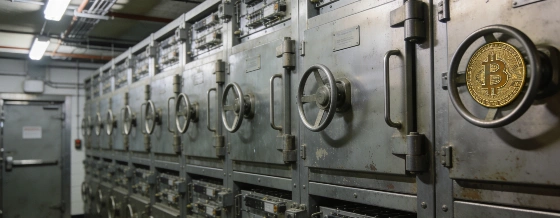
Bernstein projects Bitcoin could reach $150,000 by mid-2027 and $300,000 at the next cycle peak, but has cut its price target for Strategy due to dilution and revised cycle timing, signaling shifting expectations for institutional crypto exposure
Research firm Bernstein has revised its outlook for Bitcoin and the publicly traded Bitcoin treasury company Strategy, projecting that Bitcoin could reach $150,000 by mid-2027 and $300,000 at the peak of its next four-year cycle in 2029. At the same time, Bernstein has reduced its 12-month price target for Strategy from $450 to $350, citing increased equity dilution and a recalibration of its Bitcoin cycle timeline. The updated forecasts reflect Bernstein's view that the macroeconomic environment is increasingly favoring scarce assets like Bitcoin, as governments face rising debt and may turn to currency debasement rather than fiscal tightening.
Macro Shifts and Bitcoin's Appeal
Bernstein's latest note, led by analyst Gautam Chhugani, argues that the era of falling interest rates has ended, with U.S. sovereign debt now at $40 trillion. The firm believes that higher yields are fueling a cycle of increased borrowing costs and larger fiscal deficits, which could prompt governments to issue more debt and potentially debase their currencies. In this context, Bernstein expects demand to grow for assets that cannot be easily inflated or diluted, such as Bitcoin. The firm's base-case model prices Bitcoin as a multiple of its marginal cost of production, assuming the asset continues to follow its historical four-year halving cycle. Under this framework, Bernstein projects Bitcoin to reach $125,000 by the end of 2026, $150,000 by mid-2027, and $300,000 at the 2029 cycle peak. The firm also maintains a long-term scenario in which Bitcoin could reach $1 million by the end of 2033.
ETF Flows and Market Rotation
Bernstein points to recent ETF flows as evidence of a shift in investor behavior. According to Bloomberg Senior ETF Analyst Eric Balchunas, BlackRock's spot Bitcoin ETF (IBIT) and SPDR's gold ETF (GLD) have returned to the top 10 most-traded ETFs, displacing semiconductor funds that dominated earlier in the summer. Balchunas describes this as the "debasement trade" beginning to replace AI-driven market activity. Bernstein also highlights that about 59% of Bitcoin's total supply has not moved on-chain in the past year, suggesting strong holder conviction. In the 10 days before Bernstein's note, Bitcoin rebounded 28% after a roughly 50% decline from its October 2025 peak. The firm attributes the relatively moderate drawdown-compared to 75% to 90% declines in previous cycles-to increased participation from spot ETFs and corporate treasury buyers, which may have provided a buffer against deeper losses.
Strategy Target Cut and Institutional Scenarios
While Bernstein maintains an Outperform rating on Strategy, it has lowered its 12-month price target to $350, down from $450. The firm attributes this reduction to both an accelerated pace of equity dilution at Strategy and a revised timeline for Bitcoin's cycle. Strategy currently holds 840,447 BTC, representing about 4% of Bitcoin's total supply, and its balance sheet covers nearly four years of annual interest and preferred dividend obligations. Bernstein notes that if Strategy's STRC preferred stock recovers toward $100, the company could resume large-scale Bitcoin purchases. In a more aggressive scenario, Bernstein suggests that if institutional capital flows into Bitcoin more rapidly than expected, the asset could reach $200,000 by mid-2027 and $500,000 by 2029.
Market Data and Broader Context
As of August 2026, Bitcoin's circulating supply stands at approximately 19.7 million coins, with about 59% of that supply remaining unmoved on-chain over the past 12 months, according to Bernstein's analysis. The firm's base-case projections are built on the assumption that Bitcoin's four-year halving cycle will continue to influence price dynamics, with the next halving expected in 2028. Strategy's 840,447 BTC holding is equivalent to roughly 4% of the total Bitcoin supply, positioning it as one of the largest corporate holders globally. For comparison, the growth of tokenized real-world asset deposits has also accelerated, with platforms seeing deposits triple to $7.4 billion in a year, even as overall DeFi deposits have declined, as reported in recent research on tokenized asset trends.
Bitcoin's halving cycle is a key mechanism that reduces the rate at which new coins are created, typically every four years. This programmed supply reduction is designed to mimic the scarcity of precious metals and is often cited as a driver of long-term price appreciation. However, the impact of each halving can vary depending on broader market conditions, regulatory developments, and the pace of institutional adoption. While historical cycles have seen significant price increases following halvings, there is no guarantee that future cycles will follow the same pattern, especially as the market matures and new factors-such as ETF flows and corporate treasury activity-play a larger role in shaping demand and liquidity.