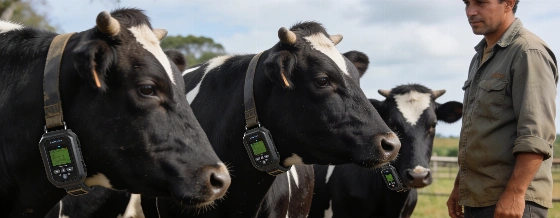
A pilot in Brazil used tokenized dairy cows as loan collateral, raising questions about whether blockchain-based livestock identity could help close the $8 trillion global credit gap for small farmers lacking land titles
Ten dairy cows in Paraná, Brazil, were recently used as collateral for a nearly $20,000 loan, with each animal's health, behavior, and location data encrypted and tracked via Cowmed collars. This pilot, which registered the cows' digital identities on B3, Brazil's main stock exchange, demonstrates how tokenizing livestock could help farmers without land titles access credit. By recording each animal's unique data on-chain, the system aims to reduce the risk of double-pledging and lower the "haircut" lenders apply to livestock-backed loans, potentially making credit more accessible and affordable for rural borrowers.
The global financing gap for small businesses is estimated at $5.7 trillion, rising to $8 trillion when informal enterprises are included, according to the World Bank. In many developing countries, farmers own valuable livestock but cannot use it as collateral because banks typically require land titles. Sub-Saharan Africa alone accounts for about $331 billion of this gap, with the African Development Bank reporting that only 6% of smallholder farmers in the region have access to formal credit. Tokenizing livestock could unlock new lending channels by turning existing assets into recognized collateral, but the approach faces significant technical, legal, and operational hurdles.
Global Experiments
Several countries are exploring ways to use livestock as collateral, but progress varies. Ethiopia, which has Africa's largest livestock population, operates an electronic registry that recognizes cattle, camels, sheep, goats, and poultry as eligible collateral. The country is developing a national livestock identification and traceability system, and its agricultural finance roadmap projects demand for livestock-related loans at roughly ETB 911 billion between 2025 and 2030. While Ethiopia has legal recognition and a growing identity infrastructure, lenders still lack reliable valuation, insurance, and enforcement mechanisms for livestock-backed loans.
Nigeria faces the largest near-term financing gap in Africa, with the International Finance Corporation estimating unmet credit demand among small businesses at $32.2 billion. The Central Bank of Nigeria's registry allows farmers to pledge livestock, including unborn animals, and checks for double-pledging. A separate identification system tags cattle with ear tags and digital passports, and a $500 million livestock program includes $70 million for access to finance. However, these systems remain fragmented, and no single product yet connects identification, registry, and financing into a seamless loan process.
Registry and Insurance Challenges
Kenya's Movable Property Security Rights Registry operates 24/7 and had registered over 34,000 livestock assets as collateral in the year to June 2023, supporting part of the KSh 5.1 trillion in credit backed by movable assets. Kenya's centralized registry already accepts livestock at scale, so tokenization must prove it can further reduce risk, lower interest rates, and improve loan terms. The system also needs to ensure that animals remain alive and healthy, and to facilitate quick substitution if an animal dies or is sold. These requirements highlight the need for robust insurance and real-time health data integration.
Pakistan, where fewer than 200,000 of 3.2 million small and medium enterprises have formal credit access, illustrates the insurance gap. Livestock accounts for 14.6% of GDP and over 62% of agricultural value added, but banks rarely accept animals as collateral due to limited insurance and unreliable veterinary data. The World Bank found that only 16% of farmers with seven to 50 animals qualified as bankable under current conditions. Without bundled insurance and verified health data, tokenization risks encouraging larger, uninsured loans that could leave borrowers and lenders exposed to loss from disease, theft, or drought.
Interoperability and Scale
Mongolia's web-based registry for movable property shows that modern electronic systems can already record livestock collateral without blockchain. By June 2023, livestock made up about 25% of the 670,000 pledge notices in the registry. The challenge now is to connect animal identity, health data, insurance, market value, and legal claims across separate systems. For tokenization to deliver better loan terms, it must enable larger loans, lower interest rates, faster approvals, and improved recovery rates compared to traditional underwriting.
In the most optimistic scenario, countries like Ethiopia and Nigeria could integrate their identification, registry, and financing systems, using Kenya's centralized model as a template. This would require insurance and veterinary data to become part of the underwriting process, shrinking haircuts and approval times while raising loan-to-value ratios. In the worst case, fragmented systems and insurance gaps could leave farmers with debt secured by uninsured or disputed animals, with little practical benefit from tokenization.
Brazil's pilot with ten tokenized cows demonstrates that the mechanics can work at a small scale, but scaling the model to millions of farmers will depend on integrating insurance, registries, and real-time data. For now, traditional databases in countries like Kenya and Mongolia already handle much of the core collateral-tracking work, raising questions about whether blockchain-based tokenization offers enough added value to justify its complexity.
According to the World Bank, the global credit gap for small and medium enterprises reached $5.7 trillion in 2023, with Sub-Saharan Africa accounting for $331 billion of that total. In Kenya, the Movable Property Security Rights Registry reported 34,638 livestock assets registered as collateral in the year ending June 2023. Nigeria's Central Bank registry and Ethiopia's electronic registry both recognize livestock as eligible collateral, but insurance and reliable health data remain key barriers to broader adoption.
Tokenization of real-world assets like livestock highlights the broader challenge of connecting digital identity, legal recognition, insurance, and enforcement in a way that delivers practical benefits for borrowers and lenders. While blockchain can provide tamper-resistant records and reduce double-pledging risk, it does not automatically solve valuation, insurance, or recovery challenges. For tokenized collateral to gain traction, it must offer measurable improvements over existing systems in terms of loan size, cost, speed, and risk management.