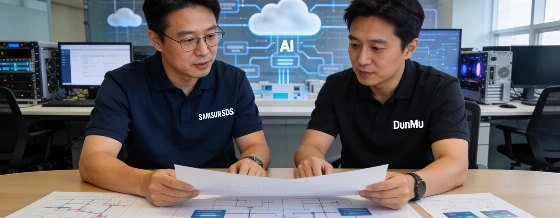
Samsung SDS is working with Dunamu, operator of Upbit, to develop stablecoin and AI-powered payment infrastructure, deepening Samsung's push into digital finance and signaling broader ambitions in blockchain-based payments.
Samsung SDS, the IT services division of South Korea's largest conglomerate, is moving to expand its role in digital finance by collaborating with Dunamu, the company behind the Upbit cryptocurrency exchange. According to Samsung SDS, the two firms are in active talks to jointly develop infrastructure for stablecoins and AI-driven payment systems, a move that could reshape how digital assets are issued, settled, and used for payments in South Korea and potentially beyond.
Stablecoin Infrastructure Talks
The partnership discussions were confirmed by Samsung SDS CEO Lee Jun-hee during the company's second-quarter earnings call. Lee stated that Samsung SDS has already completed comprehensive testing of stablecoin processes, including issuance and settlement, and pointed to the company's prior work on the Korea Securities Depository's tokenized securities platform as evidence of its technical readiness. He described the relationship with Dunamu as a strategic priority, emphasizing that the goal is to build concrete business models for digital financial infrastructure by combining Samsung SDS's cloud, security, and IT expertise with Dunamu's blockchain capabilities.
Samsung's commitment to the digital asset sector became more visible after Samsung SDS, Samsung Securities, and Samsung Card finalized a joint acquisition of a 4% stake in Dunamu in May 2026. According to the company, this investment was made for strategic reasons rather than as a passive financial holding, tying multiple Samsung affiliates to the country's growing digital asset ecosystem. The announcement of the Dunamu collaboration follows Samsung Electronics' recent decision to add stablecoin support to Samsung Wallet, suggesting a coordinated push across Samsung's business units to expand into digital payments and asset infrastructure.
AI and Cloud Expansion
Samsung SDS reported second-quarter revenue of 3.72 trillion Korean won, approximately $2.6 billion, a 5.9% increase from the same period last year. The company attributed much of this growth to its cloud services, with total cloud revenue rising 17% year over year and external cloud business revenue up 75%, driven by demand for its cloud platform and GPU-as-a-service offerings. During the earnings call, Samsung SDS also outlined a multi-year plan to expand its AI infrastructure capacity from 110 megawatts to 230 MW by 2029, with a longer-term goal of exceeding 800 MW by 2031. Digital finance services, including stablecoin and payment infrastructure, are expected to be a key part of this broader technology buildout.
Samsung SDS and Dunamu have not disclosed a timeline for when their joint stablecoin and AI payment infrastructure might launch or become available to users. Both companies declined to provide further comment beyond the earnings call. The move comes as other major players in the digital asset space are also expanding their product offerings, such as Binance's recent addition of USDT-settled gold and silver options on its ADGM-regulated Nest Exchange, following a surge in commodity perpetual futures trading volumes. For more on how leading exchanges are broadening their derivatives lineups, see this coverage of Binance's expansion into gold and silver options.
Payments and Regulatory Risks
Stablecoins, which are digital tokens designed to maintain a fixed value relative to a reference asset such as the U.S. dollar or Korean won, have become a central component of the global crypto market. Their use in payments, trading, and settlement continues to grow, but questions remain about regulatory treatment, reserve management, and the technical challenges of integrating stablecoins into mainstream financial infrastructure. Samsung's entry into this space, especially in partnership with a major exchange operator like Dunamu, could accelerate the development of new payment models and digital asset services in South Korea and potentially influence approaches in other markets.
Stablecoin infrastructure projects often face complex trade-offs between speed, security, regulatory compliance, and interoperability with existing financial systems. Integrating AI into payment systems introduces additional considerations, such as data privacy, transaction monitoring, and the risk of algorithmic errors. As large technology and financial firms move deeper into digital asset infrastructure, the practical success of these initiatives will depend on their ability to address these challenges while meeting the needs of users, regulators, and the broader financial ecosystem.