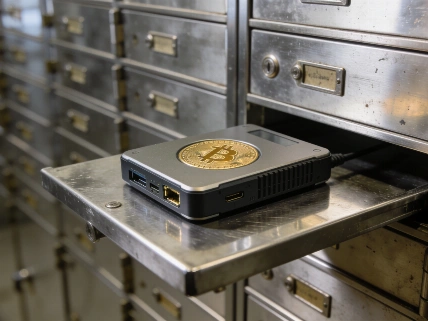


Bit Digital has pledged 74% of its staked Ethereum as collateral for a $50 million loan, exposing its treasury to rapid margin calls and making its crypto reserves a key part of a complex funding chain
Bit Digital, a U.S.-listed crypto mining and infrastructure company, has pledged nearly three-quarters of its staked Ethereum holdings as collateral for a $50 million loan from Galaxy Digital, according to recent company filings. The move allowed Bit Digital to fund its majority-owned AI infrastructure venture, WhiteFiber, without selling Ethereum or issuing new shares, but it also introduced new risks and dependencies to its crypto treasury.
Loan Structure and Collateral Mechanics
According to Bit Digital's second-quarter disclosures, the company converted 73,235 ETH into 66,192 LsETH, a liquid staking token, and pledged 49,000 LsETH-about 74% of its staked position-as collateral for the Galaxy Digital loan. The remaining 17,192 LsETH, valued at $27.6 million at the time of reporting, was held as a buffer to help meet potential margin requirements. The $50 million loan, drawn on May 20 at a 5.45% interest rate, is governed by a master loan agreement that allows Galaxy Digital to issue a margin call if the collateral value falls below a certain threshold. Bit Digital would then have 24 hours to add more collateral or risk partial liquidation of its pledged assets. In urgent cases, the cure period could be as short as nine hours. The specific collateral ratios and trigger points remain undisclosed, leaving the company's proximity to a margin call unclear.
WhiteFiber Funding and Treasury Implications
Bit Digital used the borrowed funds to support WhiteFiber, its AI infrastructure subsidiary, through a separate lending facility. This arrangement enabled Bit Digital to avoid immediate dilution or asset sales, but it also tied a significant portion of its Ethereum treasury to the performance and funding needs of WhiteFiber. The WhiteFiber facility, initially set at $100 million with the potential to increase to $150 million by mutual agreement, is backed by equity pledges and parent guarantees rather than crypto collateral. Still, the overall structure means Bit Digital's crypto reserves now play a central role in its broader capital allocation strategy.
Accounting Impact and Market Data
In the same quarter, Bit Digital recorded a $46 million non-cash impairment on its LsETH holdings, reflecting a decline in the token's value. Unlike ETH, which is carried at fair value, LsETH is accounted for at cost less impairment, so the charge did not represent a realized loss or sale. The company reported no ETH sales during the period. Staking revenue fell to $900,000 from $2.3 million in the previous quarter, while net loss attributable to shareholders reached $107.2 million. These figures highlight the volatility and accounting complexity of holding and leveraging staked assets. For context, Bit Digital's Ethereum balance sheet grew from 24,434 ETH on March 31 to approximately 100,603 ETH by July 7, 2025, as management redeployed cash from its former Bitcoin reserves, according to related coverage.
Margin Call Risk and Industry Context
The Galaxy Digital loan's margin mechanics mean that a sharp drop in Ethereum's price or LsETH's value could trigger a rapid collateral call, forcing Bit Digital to add assets or face liquidation within a day. While the company has not disclosed any margin calls to date, the lack of public collateral thresholds makes it difficult for investors to assess the risk of forced sales. This type of arrangement is not unique to Bit Digital; other crypto treasuries have faced similar collateral calls, sometimes with even shorter cure periods. For example, as discussed in EgonCoin's analysis of U.S. derivatives market tensions, rapid liquidation windows can amplify volatility and create systemic risks when collateral values swing sharply. Bit Digital's board is reportedly considering share repurchases, but any such move would require further approval.
Bit Digital's experience underscores the growing complexity of crypto treasury management as companies seek to maximize capital efficiency without sacrificing liquidity or exposing themselves to sudden forced liquidations. The use of liquid staking tokens as collateral introduces additional layers of risk, including price volatility, protocol dependencies, and opaque margin requirements. For U.S. investors and companies, understanding these mechanisms is increasingly important as more firms use staked assets to back loans, fund operations, or support new ventures.