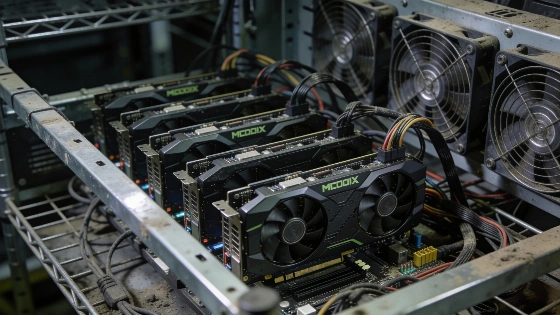
Pearl's blockchain uses GPU matrix math for mining and ties PRL token rewards to a steadily shrinking issuance curve. Miners must weigh hardware efficiency, network difficulty, and real-world AI demand.
Pearl's mining setup forces anyone with GPUs to rethink their strategy. Instead of classic hashing, Pearl's network runs on matrix multiplication. This is the same kind of math used in AI training. So, GPUs built for AI can also mine PRL tokens and help secure the network. But the payout isn't fixed.
Dynamic rewards and hardware stakes
Pearl doesn't follow Bitcoin's set halving schedule. Instead, it uses a polynomial decay formula. With every new block, the block reward drops a little. The total supply is capped at 2.1 billion PRL. But the rate of new tokens slows down block by block. At block 115,676, the independent explorer PearlTrack showed a block reward of 2,327.76 PRL and a network hashrate of about 33.68 exahash per second. Both the payout and the competition keep shifting as the network grows.
On recent blocks, Pearl's block subsidy holds steady around 2,327-2,328 PRL, with a network hashrate near 33.68 EH/s-evidence of ongoing competition and dynamic issuance.
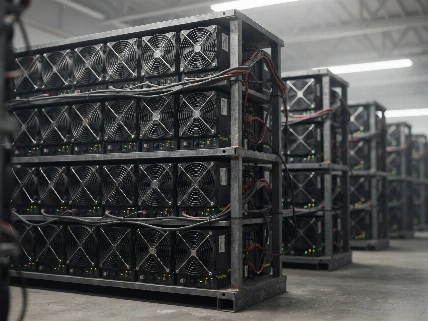
Mining on Pearl isn't just about picking the GPU with the highest hashrate on paper. Real returns depend on your share of the network hashrate, the current block reward, PRL's price, and your electricity bill. GPUs like the NVIDIA RTX 4090 and H100 have shown strong hashrate in public tests. But actual efficiency depends on power draw, VRAM, cooling, and how well your software is tuned. Pearl's mining code works with NVIDIA GPUs using CUDA. Community miners have added support for newer models. Still, the same GPU can give different results depending on your setup and environment.
Mining pools and network participation
Pearl miners can go solo-running their own node and chasing block rewards alone-or join a mining pool. Pools combine GPU power, split up the work, and check submitted shares. Fortune Pool and F2Pool already support Pearl. Pool operators have to check work efficiently without running up costs. For most miners with limited gear, pools mean steadier payouts, but you have to factor in pool fees and overhead.
To get started, miners need a Pearl wallet and a Taproot address for rewards. You can run your own node or connect to a pool with compatible mining software. The official node supports getblocktemplate RPC, and rewards go straight to your address. Pools make setup easier, but solo miners keep full control-and take on all the risk of reward swings.
Pearl's consensus is based on proof-of-useful-work, where blocks are mined through real matrix operations rather than standard hashing. Each block includes a zkSNARK proof that reveals a random fragment of the computation for audit, ensuring transparency and verifiability of useful work.
Issuance curve and long-term incentives
Pearl's reward model avoids sudden changes in miner incentives. There are no sharp halvings. Instead, the protocol uses a smooth polynomial curve. The remaining supply ratio is H / (t + H), with H set at about 650,226 blocks-roughly four years of block time. This means the block reward drops slowly, and a small trickle of new tokens continues even as the network ages. The white paper says this helps keep miners active and the network secure, instead of risking a sudden drop in rewards that could weaken the system.
For miners, this setup means early adopters get more, but rewards shrink over time. Staying profitable will depend on how efficient your hardware is, what you pay for power, and how much demand there is for AI compute. Pearl ties token rewards to useful GPU work, but it doesn't promise mining will always pay off as the network matures and rewards get smaller.
AI compute and economic divergence
Pearl's Proof-of-Useful-Work is different from standard AI GPU cloud services. Both use GPU hardware, but the economics are not the same. Cloud providers rent out GPU time for customer AI jobs. Pearl miners run protocol-set computations to secure the blockchain and earn PRL. Pearl's long-term plan is to blend AI training and inference with mining, so GPUs could help both blockchain security and real-world AI tasks. Whether this dual-use model can build a stable GPU market depends on real demand and how well the protocol works.
Other projects are also testing the overlap between AI and blockchain. As reported earlier, some platforms are trying AI-driven trading and decentralized compute. But Pearl's focus on mining as a bridge between blockchain consensus and AI computation is a different path.
Pearl's documentation says the network's difficulty adjustment aims for a block time of about 194 seconds (3 minutes and 14 seconds). It uses a Weighted-Target Exponential Moving Average (WTEMA) to react to fast changes in hashrate. This keeps block production steady even as miners come and go. The best way to measure mining efficiency is by hashrate per watt, not just raw compute power.
Pearl's mining setup and token rules are built for change. The gradual reward curve, GPU-based mining, and focus on useful computation make things complex for miners and token holders. The real test is whether Pearl can keep the network secure and meet real AI compute needs as the market changes. For now, the system rewards those who can adapt fast and tune their hardware for both efficiency and profit.
To sum up, Pearl's max supply is 2.1 billion PRL. The block reward drops at every block, following the protocol's polynomial formula. At block 115,676, the explorer showed a reward of about 2,327.76 PRL, a network hashrate near 33.68 exahash per second, and a smooth decline in rewards with no sudden halvings. These numbers show how mining rewards shift and why it's important to watch network stats if you want to join in.
Proof-of-Useful-Work is a big shift from classic proof-of-work mining. By linking token rewards to computations that could matter outside blockchain security, projects like Pearl are trying new ways to match miner incentives with bigger tech needs. This brings new challenges, like needing specialized hardware, keeping costs in check, and tracking both network and market changes. For U.S. miners and investors, it's key to understand these moving parts before putting resources into a network where both the rules and the payouts are always changing.