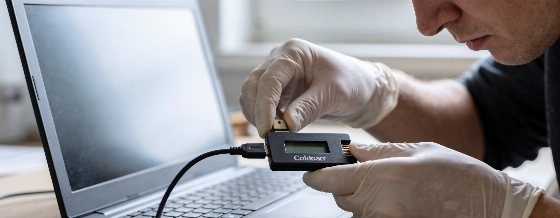
A vulnerability in Coldcard hardware wallets could let attackers remotely reconstruct private keys from seeds generated on certain firmware, putting user funds at risk and requiring urgent action.
Some Bitcoin holders using Coldcard hardware wallets may face an urgent security risk after wallet maker Coinkite disclosed a vulnerability that could allow attackers to remotely reconstruct private keys from seeds generated on affected devices. The flaw impacts Coldcard Mk3 wallets running firmware version 4.0.1 or later, as well as certain Mk4, Mk5, and Q models with older firmware, according to the company. Users with vulnerable seeds are advised to create new keys and transfer their Bitcoin to addresses generated with updated, secure firmware.
Seed Generation Weakness
The vulnerability centers on the process of seed generation-the critical step where a hardware wallet creates the random phrase that controls all future access to a user's Bitcoin. If the randomness, or entropy, used during this process is weak or predictable, attackers can narrow down the possible seed phrases and systematically test them to identify the corresponding wallet addresses. Once a match is found, the attacker can monitor those addresses and potentially spend any funds deposited there, bypassing the intended air gap and offline protections of hardware wallets.
Who Is at Risk
According to Coinkite, the highest-risk scenario involves Coldcard Mk3 wallets with seeds generated on firmware 4.0.1 or later, especially if users did not add extra entropy (such as dice rolls), did not use a passphrase, and did not set up multisignature protection. The company also notes that Mk4 and Mk5 devices are affected if running firmware before 5.6.0, and Q devices before 1.5.0Q, though the risk is described as less severe. Coinkite has announced plans for a formal technical review to determine the root cause of the flaw.
Remediation and User Actions
Firmware updates can secure future seed generation, but they cannot retroactively strengthen seeds already created with weak entropy. The only way to fully mitigate the risk is to generate a new seed on a device running secure firmware and transfer all funds to new addresses. Coinkite recommends users verify their backups, test small transfers, and migrate balances as soon as possible. While adding a unique BIP-39 passphrase can provide an extra layer of protection, migration is still advised even for those using passphrases.
Industry Implications
This incident highlights the long-term maintenance challenges of self-custody. Hardware wallets are designed to protect private keys through secure storage and offline signing, but if the initial seed is compromised, all subsequent security measures are undermined. The risk is especially acute for dormant wallets, as users who generated seeds years ago may not see manufacturer advisories or realize their funds are exposed. Similar to how exchange security lapses can leave user assets vulnerable, flaws in wallet seed generation can have lasting consequences for Bitcoin holders who rely on self-custody.
Coinkite released its final Mk3 firmware in June 2023, but the company's July 2026 advisory covers seeds created as far back as March 2021, underscoring the potential for multi-year exposure. The company's documentation emphasizes open-source code and reproducible builds as tools for independent inspection, but this incident demonstrates that even widely trusted hardware wallets can harbor subtle vulnerabilities that only become apparent years later.
According to blockchain analytics providers, Bitcoin's total supply remains capped at 21 million, with over 19.7 million BTC in circulation as of July 2026. Hardware wallets like Coldcard are estimated to secure a significant share of long-term Bitcoin holdings, though precise figures are not publicly available. Security incidents affecting wallet infrastructure can have ripple effects across the broader Bitcoin ecosystem, especially as more users opt for self-custody in response to exchange risks.
Seed phrase security is foundational to cryptocurrency self-custody. A seed phrase is a sequence of words that encodes the private key controlling a wallet's assets. The strength of a seed phrase depends on the quality of the randomness used to generate it. If the entropy is insufficient or predictable, attackers can reconstruct the seed and gain access to funds. While hardware wallets are designed to keep private keys offline and out of reach of malware, a compromised seed undermines all subsequent protections. Users should periodically review their backup and recovery practices, keep firmware up to date, and remain alert to manufacturer advisories about potential vulnerabilities.