
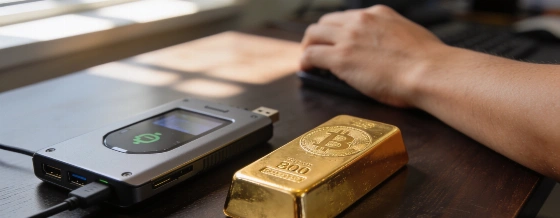
Bitcoin offers higher growth potential with sharp drawdowns, while gold delivers steadier capital preservation. Spot ETFs, supply rules, and inflation-hedge data shape how U.S. investors may weigh both assets in 2026
Bitcoin and gold are often cast as rivals for the title of ultimate store of value, yet they solve different problems for investors. Bitcoin's fixed supply and digital portability create room for outsized gains, while gold's centuries-long track record and industrial demand favor stability. Neither asset is universally superior. The practical choice depends on risk tolerance, time horizon, and whether the priority is growth or capital preservation amid inflation and geopolitical stress.
Inflation expectations, policy uncertainty in developed economies, and institutional access through spot Bitcoin ETFs have made the comparison more urgent. Gold prices have also reached fresh highs in recent cycles. For U.S. readers building diversified portfolios, the question is less about replacement and more about complementary roles-especially as digital gold products expand, including cases such as Tether's gold-backed token receiving Shariah certification.
Scarcity and supply rules
Bitcoin's protocol caps supply at 21 million coins. By mid-2026 roughly 20.05 million had been mined, more than 95 percent of the maximum, with some coins permanently lost. Halving events cut new issuance about every four years, producing a declining, predictable inflation rate that underpins the "digital gold" narrative. Monetary policy is algorithmic rather than political, which appeals to investors wary of fiat debasement.
Gold supply grows through mining and recycling, typically around 1-2 percent a year. First-quarter 2026 mine output reached a record near 885 tons, with recycling up about 5 percent year over year. Geology, costs, and environmental rules constrain production, but the stock is not hard-capped. Jewelry and industrial demand create a consumption floor Bitcoin lacks. Both assets are scarce; one scarcity is coded, the other geological.
Returns, volatility, and hedges
Historical performance gaps are large. From 2012 to 2022 Bitcoin rose nearly 3,700 percent while gold's inflation-adjusted gain was about 30 percent. ARK Invest data for a recent five-year window put Bitcoin's average annual return near 67.2 percent versus gold's 10.4 percent. In 2024 Bitcoin gained roughly 135 percent and gold about 35 percent; in 2025 Bitcoin fell about 21 percent while gold rose about 35.7 percent, illustrating Bitcoin's boom-bust pattern and gold's defensive tilt.
Wells Fargo figures show Bitcoin's annualized volatility often in the 50-80 percent range (around 54 percent in 2025) against gold's roughly 10-15 percent. Typical Bitcoin drawdowns of 50-85 percent can take one to three years to recover; gold drawdowns of 15-30 percent usually resolve faster. A 2026 Fidelity study noted low long-term correlation between the two, supporting combined holdings for diversification. Research from Baur (2025) and others finds gold more consistent as an inflation and recession hedge, while Bitcoin's safe-haven behavior has been uneven and sometimes equity-like under stress.
Access, custody, and regulation
Bitcoin trades around the clock, settles in minutes, and divides into satoshis, lowering barriers for small allocations. Network fees and secure key management remain costs. Physical gold needs vaults, insurance, assay, and dealer premiums; ETFs and tokenized gold ease logistics but reintroduce counterparty risk. Gold's market infrastructure-central-bank reserves, deep futures, mature tax treatment-is more established. Spot Bitcoin ETFs have widened institutional access in major jurisdictions, yet classification and tax rules still vary by country, adding complexity for U.S. holders who must track capital-gains treatment carefully.
Liquidity is generally strong for both in normal conditions, though Bitcoin can thin under regulatory pressure or sharp moves, and large physical gold transfers remain slower. Self-custody of Bitcoin requires hardware wallets or multisig discipline; exchange custody depends on proof-of-reserves practices and operational controls. Gold's physical durability reduces some digital threats but raises storage and transport frictions.
Portfolio construction often treats gold as a ballast and Bitcoin as a high-conviction growth sleeve sized for drawdowns above 50 percent. Low long-term correlation supports modest dual exposure for investors who accept crypto volatility. Bitcoin has not displaced gold's crisis behavior, industrial demand, or regulatory clarity for most allocators, yet it adds programmable scarcity and global transferability gold cannot match. Suitability still hinges on individual goals, liquidity needs, and risk capacity rather than a single "winner."
Store-of-value assets succeed when scarcity, durability, divisibility, and broad recognition hold under stress. Bitcoin's recognition has grown with ETFs and corporate treasury use, but its short history and equity-like episodes in risk-off markets limit claims that it fully replicates gold. Gold's recognition rests on millennia of monetary use and ongoing central-bank holdings. Combining both can reduce single-asset path dependence, provided position sizes reflect the fourfold volatility gap and the different recovery timelines after major drawdowns. Tax lots, custody choices, and rebalancing rules matter as much as the headline scarcity story when either asset enters a U.S. taxable account.