
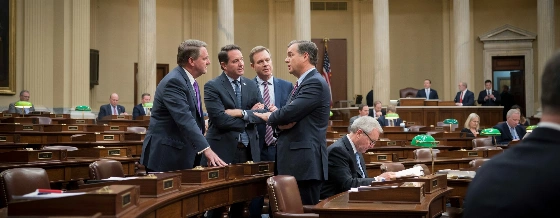
The CLARITY Act, a key crypto market-structure bill, is missing from the Senate's immediate agenda, leaving lawmakers with just 72 hours to secure a procedural vote before the August recess and raising uncertainty for U.S. digital asset regulation.
The U.S. Senate has left the CLARITY Act off its published schedule for Monday, narrowing the window for lawmakers to advance the high-profile crypto market-structure bill before the chamber's August recess. With only a spending bill vote listed for the day, the absence of the CLARITY Act signals that Senate leaders have not yet committed to bringing the legislation to the floor, despite mounting pressure from industry advocates and some lawmakers to clarify digital asset regulation.
Procedural Hurdles
Under current Senate rules, moving the CLARITY Act forward requires navigating a series of procedural steps. The most common path-filing for cloture-demands signatures from at least 16 senators and typically results in a vote two days after filing. Even if cloture is invoked, the initial vote would only determine whether the Senate proceeds to consider the bill, not its final passage. This process can consume valuable floor time, especially as the Senate approaches its scheduled August 10 recess.
Alternative Paths and Uncertainty
Senate leadership could accelerate the process through a special bipartisan petition or by seeking unanimous consent, both of which would require broad agreement across party lines. However, any single senator can block unanimous consent, and assembling the necessary coalition for a bipartisan petition is complex. The legislative vehicle for the CLARITY Act also remains unsettled, with options including the House-passed H.R. 3633 or a merged proposal introduced by Sen. Cynthia Lummis. The Senate's official cloture ledger, updated through July 31, shows no recent filings for the CLARITY Act, further clouding the bill's immediate prospects.
Democratic Support in Question
Support for the current draft of the CLARITY Act is not assured. Seven Democratic senators involved in negotiations have expressed concerns that the bill's language does not fully address their priorities, though they have committed to continued discussions. Sen. Elizabeth Warren has publicly opposed the revised text. According to reporting from Axios, Majority Leader John Thune has indicated that a procedural vote is unlikely unless enough Democrats signal support for advancing the bill. Without a clear path to 60 votes-the threshold typically required to overcome a filibuster-the bill's fate remains uncertain as the recess deadline approaches.
Market Impact and Next Steps
The CLARITY Act's delay comes at a time when U.S. crypto market participants are seeking greater regulatory certainty. The bill aims to define the legal status of digital assets and establish clearer rules for exchanges, custodians, and token issuers. Its progress is closely watched by industry stakeholders, who argue that regulatory ambiguity has contributed to fragmented compliance practices and limited access to traditional financial services. The next decisive step will be procedural: Senate leaders must identify the legislative vehicle and either file for cloture by Wednesday, assemble a bipartisan petition, or secure unanimous consent to move forward before the recess. Any new filing or leadership announcement could quickly change the outlook for the bill.
According to data from the U.S. Senate's official legislative tracker, the last recorded action on H.R. 3633-the House-passed version of the CLARITY Act-occurred on July 30, with no subsequent Senate filings as of July 31. The Senate is scheduled to reconvene at 3 p.m. Monday, with only a spending bill vote currently on the agenda. The chamber's next state work period begins August 10, leaving a narrow window for any additional legislative action on digital asset regulation before the fall.
Senate procedure for advancing major legislation like the CLARITY Act highlights the complexity of U.S. lawmaking, especially for bills that touch on emerging technologies and financial markets. Cloture, the process for ending debate and moving to a vote, is designed to prevent indefinite filibusters but also requires significant bipartisan support-typically 60 votes when all seats are filled. Alternative mechanisms, such as unanimous consent or special petitions, can speed up the process but are rarely used for contentious issues. For the crypto industry, the outcome of this legislative maneuvering will shape the regulatory environment for exchanges, token issuers, and investors in the months ahead.