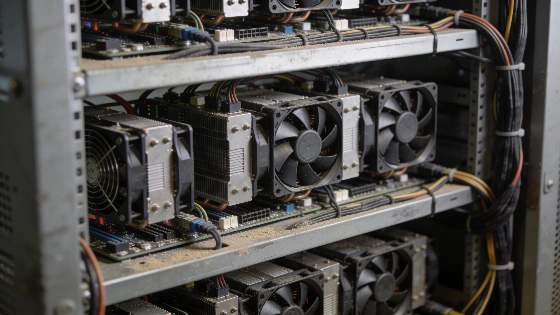
Qubic miners now earn QUBIC by training AI models, not solving random hashes. Top performers become Computors, while others join pools or use Scrypt ASICs for Dogecoin buybacks.
Qubic mining has thrown out the old crypto mining script. Instead of burning power on pointless hash puzzles, miners now use their hardware to train neural networks for Aigarth, Qubic's decentralized AI project. Only the best miners-called Computors-get direct protocol rewards. The rest rely on pool payouts or try other mining routes.
AI training as mining
Bitcoin's proof-of-work wastes energy on cryptographic puzzles. Qubic's Useful Proof of Work (uPoW) puts CPU and GPU cycles to work training and testing neural networks. Every Solution a miner submits must hit a set difficulty and help Aigarth learn. Mining output is measured by how much and how well you train AI, not by raw hash rate. The protocol releases a fixed 1 trillion QUBIC every seven days. Rewards go to miners based on their performance rank, not a fixed difficulty. Qubic doesn't need ASICs-regular CPUs and GPUs are enough. This opens the door for more people to join in.
Qubic's Useful Proof of Work (uPoW) model directs miners' computational resources toward real AI training tasks, not arbitrary hashes, and supports mining with standard CPUs and GPUs.
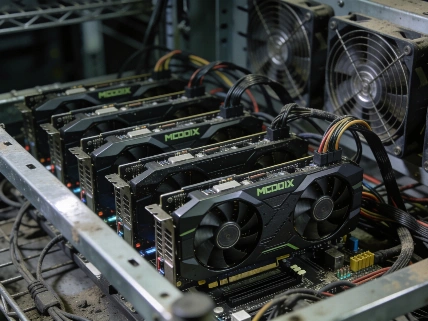
Anyone can mine with a consumer CPU or NVIDIA GPU. ASICs are only needed for the Doge-Connect path. The official qli-Client works on several operating systems and lets users mine with or without registration. Pool payouts come weekly. The Qubic.li pool uses a pay-per-share-plus (PPS+) model, which helps smooth out rewards for smaller miners. Solo mode is also an option for those who want direct Solution-based payouts.
Computor selection and network roles
Qubic splits its network into two main roles: AI Miners and Computors. AI Miners generate Solutions for Aigarth. Computors handle transaction validation, smart contract execution, and network security. Each week, the top miners by Solution output move up to Computor status, replacing those who fall behind. Computors need a two-thirds-plus-one majority to finalize transactions, using Byzantine fault tolerance to stop small groups from taking over.
New miners start as Candidates. They help train AI but don't get direct rewards at first. Only after reaching the top ranks do they qualify for Computor rewards in the next epoch. This setup ties mining performance to governance. Validator seats are always up for grabs-no one is guaranteed a spot. In 2026, Qubic rolled out two big upgrades: the BPP-9000 algorithm (live since August 2026) and the ant colony mining framework (active from epoch 228). Both changes made the network more efficient and decentralized.
Qubic is positioned as a Layer 1 distributed computing network founded by Sergey Ivancheglo, emphasizing decentralized computation, AI training, and smart contract execution. The project's mission is to transform energy into intelligence, building an open AI infrastructure owned by the community.
Doge-Connect and parallel mining paths
Qubic also offers Doge-Connect for miners with Scrypt ASIC hardware. This is a separate mining route that uses Dogecoin hashpower. ASIC miners send shares through the Stratum protocol. The DOGE they mine is sold to buy QUBIC on the open market. Some of this QUBIC goes to Computors, and any extra is burned. Doge-Connect runs independently from AI mining. CPU/GPU and ASIC miners don't compete for the same rewards or hardware.
Doge-Connect only works with Scrypt ASICs like the Antminer L7 or L9. It doesn't accept CPUs or GPUs. Shares are checked on-chain by Oracle Machines, not off-chain like in regular Dogecoin pools. Miners get paid in DOGE, which is then swapped for QUBIC. The buyback and burn process changes the token supply and how rewards are split. Operators can run both mining paths at once, but each uses different hardware, validation, and payout rules.
Risks, costs, and tokenomics
Qubic mining isn't a sure bet. Miners face hardware and electricity costs, and the fight for Computor seats keeps getting tougher. Pool fees, payout models, and price swings for QUBIC and Dogecoin add more risk. After Epoch 175, the weekly burn rate jumped from 15% to 55%. This cut the net emissions miners can earn. Future halvings need a Quorum vote, so tokenomics could keep changing.
All QUBIC in circulation comes from weekly emissions. There's no premine or VC allocation. Computor rewards are capped at 1,479,289,940 QUBIC per epoch, but actual payouts usually hit 90-98% of that cap, depending on performance. Miners who aren't Computors get pool payouts at the end of each epoch. QUBIC can be bought or sold on spot markets, but mining and trading each carry their own risks.
Qubic's official docs say the mainnet launched in 2022 with a fair distribution. The first halving at Epoch 175 in August 2025 raised the burn rate and squeezed miner rewards. Doge-Connect went fully live after Epoch 210 in April 2026, replacing older external mining setups. For more on how meme tokens and tokenized assets fit into Qubic's world, check EgonCoin's previous coverage.
Right now, Qubic's protocol emits a fixed 1 trillion QUBIC every seven days. Computor rewards are capped at just under 1.48 billion QUBIC per epoch. With the burn rate at 55% after the first halving, most new tokens are burned each week. The rest go to Computors, the CCF (about 8%), and QEarn (roughly 12.25%). Pool payouts depend on Solution performance and pool rules. Doge-Connect's buyback adds QUBIC demand and cuts supply, but miner returns still depend on hardware, ranking, and market swings.
Qubic's mining model marks a real shift in how blockchains use computing power. By linking rewards to AI training instead of random hashes, the protocol tries to make mining useful. But this brings new risks, like needing steady AI training demand, changing token emissions, and constant competition for validator seats. For U.S. miners and users, the bottom line is simple: Qubic mining works with consumer hardware, but profits depend on staying ahead in the performance race, knowing the tokenomics, and managing both protocol and market risks.