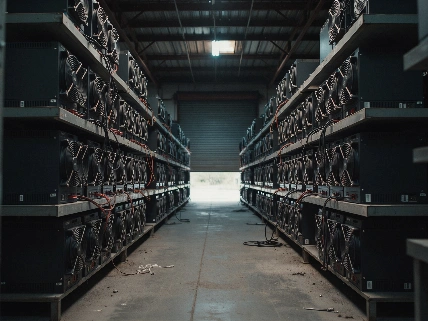

Canaan's July mining report counted nearly 35% of its global operating hashrate from paused Ethiopia sites, raising questions about how much capacity was actually active and complicating comparisons for investors and analysts
Canaan's latest mining update has drawn scrutiny after the company included nearly 5 exahashes per second (EH/s) from its paused Ethiopia operations in its July global operating hashrate total. The company reported 14.24 EH/s of operating computing power for the month, but 4.96 EH/s-about 35% of the total-came from Ethiopia, where Canaan acknowledged mining was on hold but did not clarify how much, if any, capacity was actually hashing at the end of July.
Hashrate Reporting Methods
According to Canaan's disclosures, the company defines "operating computing power" as the theoretical output of all energized mining machines, regardless of whether they are currently hashing. This approach means that temporarily offline machines, such as those in Ethiopia, are still counted in the operating total. The July update assigned the full 4.96 EH/s to both the operating and installed columns for two Ethiopia projects, while a footnote stated that mining in the country was paused. The company did not specify whether any of the machines remained powered or contributed to actual Bitcoin mining during the reporting period.
Ethiopia Capacity Fluctuations
In June, Canaan listed only 0.36 EH/s of operating computing power in Ethiopia, reflecting a temporary shutdown at one site due to local power-grid maintenance. By July, the company returned the full 4.96 EH/s to the operating column, even as it described the country's mining as paused. This shift complicates efforts to estimate Canaan's live hashrate, since subtracting the Ethiopia figure from the global total (leaving 9.28 EH/s) does not necessarily yield an accurate measure of active mining capacity. The company's reporting structure, which distinguishes between installed, operating, and joint-venture capacity, makes direct comparisons challenging.
Production and Joint Ventures
Canaan reported mining 46 BTC in July and holding 1,917 BTC and 3,952 ETH at month-end. However, these production figures do not account for every row in the company's global capacity table. Canaan also operates several joint ventures in West Texas, including Alborz, Bear, and Chief Mountain, in which it holds a 49% stake. The company says output from these ventures is excluded from its reported Bitcoin production and average all-in power-cost calculations, even though their capacity appears in the global projects table. This reporting approach is not unique to Canaan; other mining companies have also faced questions about how they classify idle or paused equipment in public filings. For example, MGT Capital's recent share issuance highlighted similar issues around idle mining machines and operational uncertainty.
Implications for Investors
Canaan's method of reporting theoretical operating capacity rather than live hashrate may affect how investors and analysts interpret its performance. Without clear disclosure of how much capacity is actively hashing, it becomes difficult to assess the company's true mining output, efficiency, and cost structure. The lack of detail around the status of paused operations, especially in regions like Ethiopia where power and regulatory conditions can be volatile, adds further uncertainty for stakeholders tracking the company's operational health.
As of July 31, Canaan reported 14.24 EH/s of operating computing power, with 4.96 EH/s attributed to Ethiopia and 9.28 EH/s to other locations. The company's July Bitcoin production was 46 BTC, and its digital asset holdings included 1,917 BTC and 3,952 ETH. These figures are based on Canaan's self-reported data and may not reflect actual live mining activity, particularly given the inclusion of paused or offline equipment in the operating total.
Mining companies often face trade-offs in how they report capacity, especially when operations are disrupted by local power issues, regulatory changes, or maintenance. The distinction between installed, operating, and live hashrate is critical for understanding a miner's real-world output and profitability. Investors should pay close attention to how these terms are defined in company filings, as headline figures may not always represent the amount of computing power actually contributing to Bitcoin network security or generating revenue at a given time.