Major Bitcoin mining firms are redirecting capital and power to AI data centers as mining profits fall, but this strategic pivot could backfire if Bitcoin prices rebound and AI demand lags behind expectations
Bitcoin miners are rapidly reallocating billions of dollars and significant power resources from traditional mining operations to artificial intelligence (AI) data centers, as the economics of mining have deteriorated in 2024. With Bitcoin trading near $64,000-well below its late 2023 highs-and network competition at record levels, many miners are finding it increasingly difficult to generate profits from mining alone. According to CryptoSlate, the combination of lower Bitcoin prices, reduced block rewards after the April 2024 halving, and persistently weak transaction fees has pushed mining revenue close to historic lows.
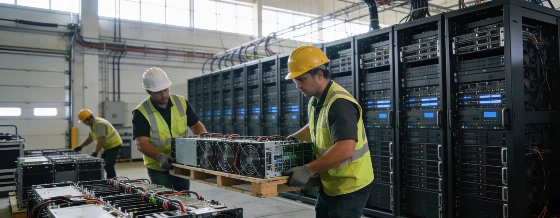
These pressures have made AI infrastructure an attractive alternative. Data-center customers in the AI sector are willing to pay a premium for reliable electricity and long-term capacity, allowing miners to monetize their power assets more effectively than by mining Bitcoin alone. Some of the largest mining companies have already begun converting facilities, signing multi-year contracts for high-performance computing, and pausing or canceling new investments in mining hardware.
Timing Risks and Market Uncertainty
Yet, this pivot carries significant timing risk. Industry analysts, including André Dragosch of Bitwise Europe, warn that miners may be shifting focus at a vulnerable point in the cycle. While AI demand is widely expected to grow, the pace and scale of that growth remain uncertain. Dragosch argues that the anticipated surge in AI compute demand-especially from emerging technologies like autonomous agents-could take longer to materialize than current investments assume. At the same time, he believes Bitcoin may be nearing the end of its downturn, raising the possibility that mining economics could improve just as miners commit resources to AI, leaving them with less flexibility to benefit from a potential recovery.
The economics of mining have become especially challenging since the April 2024 halving, which reduced the block subsidy from 6.25 BTC to 3.125 BTC. This cut the number of new coins miners receive for securing the network, while the subsequent decline in Bitcoin's price further reduced the dollar value of those rewards. According to VanEck, miners' daily revenue has dropped nearly 40% year over year, averaging about $28.5 million over a recent 30-day period. Meanwhile, network hashrate remains elevated, keeping competition for rewards intense and pushing hashprice-miner earnings per unit of computing power-to around $30 per petahash per second per day, near record lows.
AI Pivot Gains Momentum
For some miners, the gap between mining and AI revenue has become too large to ignore. Core Scientific, once among the largest Bitcoin miners, has announced it will no longer invest in new mining equipment to maintain or expand its hashrate. Instead, the company is focusing on extracting cash from its existing fleet and redirecting power to high-density computing for AI clients. In its most recent quarter, Core Scientific reported colocation revenue of $136.7 million-up from $10.6 million a year earlier-accounting for 83% of total revenue. By contrast, Bitcoin self-mining revenue fell 66% to $21.5 million, representing just 13% of revenue, down from 80% a year earlier. The profitability gap is stark: colocation delivered a 59% gross margin, while self-mining produced a negative margin.
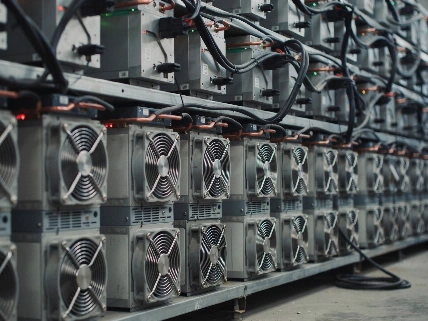
Core Scientific is not alone. According to CoinShares, public miners have announced more than $70 billion in cumulative AI and high-performance computing contracts. The firm estimates that listed Bitcoin miners could derive as much as 70% of their revenue from AI by the end of 2026, up from roughly 30% today. MARA Holdings CEO Fred Thiel has described the shift in simple terms: AI customers pay far more per unit of electricity than Bitcoin mining can currently support. While miners cannot repurpose their specialized Bitcoin mining hardware (ASICs) for AI workloads, they can leverage their access to electricity, grid connections, land, and data-center infrastructure-assets that have become increasingly valuable as AI developers compete for suitable sites.
Capital Commitments and Competitive Pressures
The transition to AI infrastructure is not without its own risks. Building high-performance computing facilities for AI is far more capital-intensive than expanding Bitcoin mining operations. CoinShares estimates that while Bitcoin mining infrastructure costs about $700,000 to $1 million per megawatt, AI data centers can require $8 million to $15 million per megawatt. This means miners moving into AI are making larger, longer-term capital commitments, often during a period of record technology infrastructure spending. The Bank for International Settlements projects that the five largest hyperscalers could spend over $1 trillion on AI-related capital expenditures across 2025 and 2026. The BIS has cautioned that if commercial returns do not keep pace with this investment, the sector could face overcapacity, slowing new development and making financing more difficult for projects that depend on continued growth in AI demand.
Dragosch and other analysts do not dispute the long-term potential of AI, but they caution that infrastructure supply could outpace commercial demand in the near term. If Bitcoin mining profitability recovers while miners are locked into long-term AI contracts, operators may find themselves unable to pivot back quickly, potentially missing out on improved mining economics. The risk is that miners, in chasing the more attractive economics of AI today, may sacrifice the optionality needed to respond to a changing market environment.
Market Data and Industry Impact
As of June 2024, Bitcoin's network hashrate remains near all-time highs, reflecting intense competition among miners despite falling profitability. According to data from CryptoSlate, Bitcoin traded around $64,000 in early June, down nearly 50% from its October 2023 peak. VanEck's research shows that average daily miner revenue has dropped to approximately $28.5 million over the past month, with hashprice hovering near record lows. Meanwhile, public miners have collectively announced over $70 billion in AI and high-performance computing contracts, signaling a major shift in industry priorities and capital allocation.
The current wave of investment in AI infrastructure by Bitcoin miners highlights the complex trade-offs facing the sector. While the move offers a potential lifeline amid depressed mining economics, it also exposes operators to new forms of risk, including uncertain AI demand, high capital costs, and reduced flexibility if Bitcoin's market conditions improve. For U.S. miners and investors, the outcome will depend on how quickly AI demand materializes and whether Bitcoin's mining economics rebound in the coming year.
Bitcoin mining profitability is shaped by a combination of factors, including block rewards, transaction fees, network hashrate, and the market price of Bitcoin. The halving events, which occur roughly every four years, reduce the number of new coins issued and are designed to control inflation. However, when combined with falling prices and rising competition, halvings can push older or less efficient mining equipment below breakeven, forcing operators to seek alternative revenue streams or exit the market. The current shift toward AI infrastructure reflects both the challenges and the adaptability of the mining sector, but it also underscores the importance of timing and capital allocation in a rapidly evolving digital economy.