Bitcoin traders brace for the Federal Reserve's July decision as Chairman Kevin Warsh abandons decades of market guidance, raising the risk of a surprise rate hike and potential volatility across crypto markets
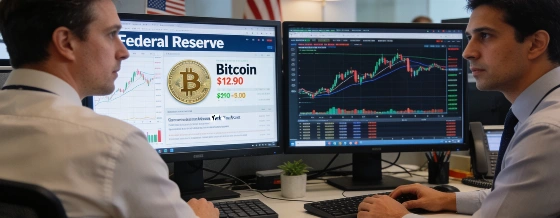
Bitcoin's price slipped in the lead-up to the Federal Reserve's July policy meeting, as traders weighed the possibility of a surprise interest rate hike under Chairman Kevin Warsh. The largest cryptocurrency dropped as much as 3% to $62,913 before partially recovering, according to CryptoSlate data, reflecting heightened anxiety over the Fed's next move. The central bank has held its benchmark rate steady at 3.50% to 3.75% since December, despite repeated calls from President Donald Trump to lower borrowing costs. While most investors expect rates to remain unchanged, futures markets have priced in roughly a one-in-three chance of a 0.25 percentage point increase, leaving risk assets-including Bitcoin-vulnerable to abrupt repricing if the Fed tightens policy.
Bank of America has highlighted that markets are unusually underprepared for a potential hike, with only about 10 basis points of tightening reflected in futures-far less than the 25 basis points that would result from a standard increase. The last time the Fed raised rates with such low market expectations was in 1994. Block Scholes, a crypto analytics firm, estimates the probability of a hike at 33.7%, noting that only two Fed meetings since 2015 have seen markets this divided so close to a decision. The shift in approach under Warsh, who has rejected the Fed's traditional practice of guiding markets ahead of policy changes, has made outcomes harder to predict and increased the risk of market volatility.
Fed's New Approach
Under Warsh, the Federal Reserve has moved away from the consensus-building and forward guidance that defined previous chairs. Instead, Warsh has emphasized data-driven decisions and open debate among policymakers, making it more difficult for traders to anticipate the central bank's actions. Jim Bianco of Bianco Research argues that this change justifies a higher perceived risk of a rate hike, even if futures markets show limited tightening. A decision to hold rates steady in July would not necessarily settle the debate, as a larger increase could still be on the table for September.
President Trump has publicly praised Warsh while criticizing other Fed officials for resisting lower rates, underscoring the visible divisions within the committee. Citadel Securities is reportedly positioned for a less expected outcome, forecasting a 25-basis-point hike to reinforce Warsh's inflation-fighting credentials and demonstrate that the Fed is no longer committed to preparing markets for every move. For Bitcoin, the greater risk may lie in how investors interpret the Fed's future policy path, rather than the immediate impact of a single rate increase.
Market Impact and Bitcoin's Position
According to Bank of America, a July rate hike could prompt markets to price in more tightening through 2026, potentially raising expectations from 45 to 60 basis points. This would force a broader reassessment of how restrictive U.S. monetary policy could become, with implications for all risk assets. Bitcoin enters this environment after a period of mixed signals: U.S.-listed spot Bitcoin ETFs saw $477 million in net outflows over the past three trading sessions, based on SoSoValue data, reversing a previous trend of inflows ahead of the Fed decision.
Social sentiment data from Santiment shows that anxiety around the Fed meeting has intensified, with discussions about rate hikes, cuts, and holds all rising sharply. Despite this uncertainty, Bitcoin has gained roughly 9% month-to-date, while the S&P 500 has remained flat and semiconductor stocks have fallen nearly 20%. This divergence complicates assumptions about how Bitcoin will respond to a potential rate hike, as the market's reaction may depend more on the element of surprise and the Fed's messaging than on the size of the move itself.
Broader Risks and Investor Expectations
A more aggressive tightening cycle could eventually create new risks for the Fed by weakening financial conditions enough to limit further rate increases. Marc des Ligneris of CoinShares notes that many investors have come to expect a "Fed put"-the idea that the central bank will intervene if market conditions deteriorate significantly. If tighter policy triggers a deeper market unwind, the Fed could eventually pivot back toward easing, which might benefit assets like Bitcoin and gold. For now, however, a quarter-point hike would not signal imminent financial stress or a reversal in policy, but it would challenge the three-decade pattern of market-guided Fed decisions and force traders to reconsider the likely path for rates through 2026.
As of July 2026, Bitcoin's price remains sensitive to shifts in U.S. monetary policy, with traders closely watching the Fed's evolving approach under Warsh. The outcome of the July meeting-and the signals it sends about future tightening-could have a lasting impact on how investors price risk across both crypto and traditional markets.
On July 16, 2026, Bitcoin traded between $62,913 and $63,795, according to CryptoSlate. U.S.-listed spot Bitcoin ETFs recorded $477 million in net outflows over the three trading sessions preceding the Fed's July policy meeting, based on SoSoValue data. Futures markets assigned a roughly 33% probability to a 0.25 percentage point rate hike, while only about 10 basis points of tightening were priced in, according to Bank of America and Block Scholes.
The Federal Reserve's shift away from predictable forward guidance has introduced new uncertainty for both crypto and traditional markets. For Bitcoin, this means that price reactions to Fed decisions may become more volatile and less tied to historical patterns. As the central bank prioritizes data and internal debate over market signaling, traders and investors may need to adjust their strategies to account for a wider range of possible outcomes and a less transparent policy process.