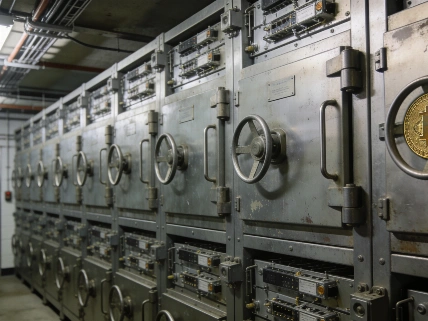
XRP's supposed 63 billion circulating tokens paint a misleading picture of what buyers can actually access. Exchange depth, custody, and price levels set the real boundaries for traders.
Glance at XRP's supply stats and it looks like a tidal wave of tokens is ready to trade. The reality is far messier. The number of XRP coins that buyers can actually snap up at a given price falls well short of the 63 billion circulating supply figure that dominates crypto dashboards.
Circulating Supply: A Blunt Instrument
Circulating supply gets tossed around as a stand-in for liquidity, but with XRP, it's a rough estimate at best. CryptoSlate's market page pegged the number at 63.09 billion XRP in circulation on October 8. XRP Insights, which tracks ledger data, counted 68.59 billion XRP outside Ripple escrow after burns. These numbers don't match, and neither one tells you how much XRP is actually for sale right now.
After Ripple's October 2026 escrow operations, approximately 31.85 billion XRP-about 31.9% of the original 100 billion supply-remained locked in escrow contracts.
Exchange order books cut through the headline noise. On October 8, CoinGecko's "+2% Depth" column showed just $2.4 million in XRP available within 2% of the current price on Binance's XRP/USDT pair and $4.0 million on Coinbase's XRP/USD pair. These numbers jump around as traders add or pull orders, and they only cover two pairs. The real supply depends on how much buyers are willing to pay above spot and what sellers are actually offering at those levels.
Custody and Exchange Wallets: The Hidden Layer
Custody arrangements muddy the waters even more. XRP Insights tallied 21.97 billion XRP in exchange-attributed wallets across 699 wallets and 24 venues as of 08:00 UTC on October 8. These balances mix pooled customer assets and cold storage, not just tokens up for grabs. Some coins are locked, dormant, or parked by holders who have no plans to sell at current prices.
Big XRP stashes also sit in protocol escrow or investment vehicles. Ripple's June 30, 2026, disclosure listed 37.656 billion XRP held overall, with 32.6 billion in escrow. XRP Radar put founders' holdings at 4.60 billion XRP as of January 16, 2026, and flagged 531 million XRP as possibly lost or inaccessible, though those numbers aren't fully confirmed. Bitwise's 419.96 million XRP and Franklin's 295.83 million XRP are locked in funds, off-limits to retail buyers since only authorized participants can redeem them.
Ripple's escrow mechanism, established in 2017, locks up billions of XRP in programmable contracts, releasing up to 1 billion XRP at the start of each month. Unused tokens are typically returned to escrow, meaning not all unlocked XRP enters the market immediately.
Definitions and Methods: No Single Truth
Data providers use their own playbooks for calculating circulating supply. CoinGecko leaves out escrowed tokens and may also skip unlocked team or foundation holdings. Subtracting these again from a provider's figure risks double-counting. The result is a tangle of overlapping numbers that can't be simply added or subtracted to get a clean "float."
Even inside exchange wallets, not every XRP is up for sale. XRP Insights leaves out identified U.S. spot ETF custody wallets without public exchange labels from its exchange total. In the week before October 8, balances in these wallets dropped by 44 million XRP. These moves reflect internal transfers and shifting custody, not just market sales.
Liquidity Hinges on Orders and Price
For buyers, only the XRP actually offered at a price they'll pay matters. Order book depth-how much XRP sits at each price-sets real liquidity. This number moves constantly, shaped by trader behavior and exchange rules. Protocol escrow is a hard stop: those tokens stay locked until release conditions are met.
Thin liquidity can turn small moves into wild swings. As reported earlier, mass redemptions and thin trading in XRP-linked vehicles have triggered sharp price drops and delayed listings. For XRP itself, the gulf between headline supply and real executable orders means big buyers can face steep slippage, and retail traders may find the market shallower than it looks.
On October 8, XRP Insights showed 21.97 billion XRP in exchange-attributed wallets, while CryptoSlate listed 63.09 billion as circulating. That gap shows how much supply is tied up in custody, escrow, or dormant accounts. Bitwise and Franklin's funds together held 715.79 million XRP as of early October, but those tokens are locked away from ordinary investors. Protocol escrow locked up 31.40 billion XRP, according to XRP Insights, further shrinking the pool of tokens that could hit the market soon.
Circulating supply is a staple metric in crypto, but it doesn't guarantee liquidity. Tokens in escrow, locked by protocol, or controlled by funds and foundations may be technically outside escrow but still unavailable for trading. Exchange order books only show what's on offer at specific prices, and large trades can quickly drain available liquidity, pushing prices sharply. For XRP and other tokens, knowing the mechanics of custody, order book depth, and protocol locks is critical for reading real market conditions and steering clear of sudden slippage or illiquidity.