A Bitcoin app's balance does not prove a phone is mining or that BTC can be withdrawn. Check where its hashrate comes from and how payouts work.
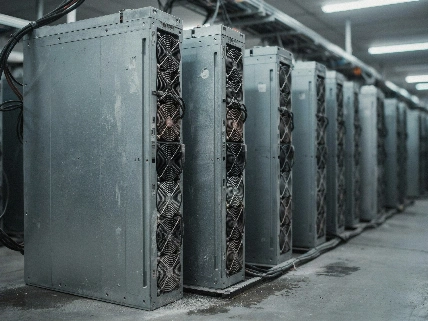
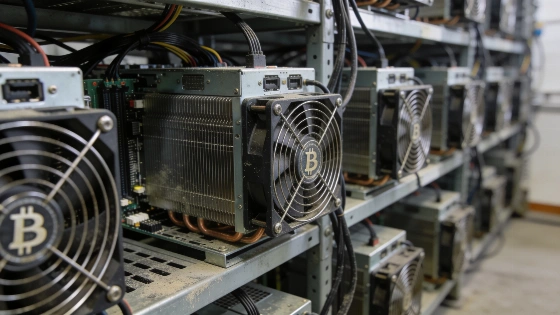
Bitcoin miners use computing power to compete to add blocks to the network. The hashing happens on specialized ASIC machines, not on the phones displaying most mining apps. Those apps usually act as remote controls, marketplaces or dashboards for activity taking place elsewhere.
Modern Bitcoin ASICs calculate SHA-256 hashes. Their performance is measured in hash rate, while energy efficiency is expressed in joules per terahash, or J/TH. A balance on a screen is not proof that mining occurred. It also does not show that BTC can be withdrawn.
The scale of the industry makes the gap between a phone interface and mining equipment plain. A Cambridge Centre for Alternative Finance study covered 49 mining companies in 23 countries. Those companies represented about 48% of global hashrate at the time of data collection. The associated estimate put Bitcoin mining's annual electricity use at 138 TWh, or roughly 0.54% of global electricity consumption. By June 2024, average equipment efficiency was estimated at 28.2 J/TH, an improvement of about 24% from the previous year.
The rub is what the app actually connects to. Users need to know where its hashrate comes from, what fees apply and whether a payout can be checked outside the service.
Start with the job
Mobile mining products serve different purposes. Rig managers help people who already operate equipment. Hashpower marketplaces let users buy or sell access to mining power. Cloud-contract interfaces display agreements tied to remote mining, while free "BTC Miner" apps may simulate progress or make money from ads.
Examples include NiceHash, which is presented as a fit for users managing existing rigs or dealing in hashpower through its marketplace. Minerstat focuses on operational monitoring across multiple devices. Kryptex Mobile is described mainly as a tool for pool statistics, balances and device status.
Cloud panels modeled on ECOS-style apps form another category. Free "BTC Miner" listings form a separate one. These are examples of different use cases, not a ranking of investment returns or proof that every service is available in every store or jurisdiction. None of these app roles turns a phone into a Bitcoin ASIC.
Kryptex's discussion of Android mining for CPU-friendly coins such as Monero concerns a different algorithm and asset. It should not be confused with Bitcoin mining, which uses SHA-256 and specialized hardware. Similar labels can obscure very different operating models, as this product-name comparison also illustrates.
Check the evidence
A credible app should say whether it manages remote equipment. It should explain if it routes orders to a hashpower market or displays a cloud contract. Fees and contract terms need to be clear, as does the withdrawal process. A balance visible only inside an app is not an on-chain payout record. A small test withdrawal to an address the user controls offers a more concrete check, though it cannot guarantee that future withdrawals will remain available.
Mining economics do not support fixed-return promises. Output changes with network difficulty, and electricity costs affect profitability. Fees matter too, as does Bitcoin's price. A dashboard estimate is not realized profit; stated hashrate and projected output need to be weighed against costs and the provider's terms. Electricity can account for more than 80% of cash operating expenses for industrial miners, according to Mining Disrupt's ASIC guide.
Cloud-mining interfaces call for a separate level of scrutiny. A contract may provide exposure to remote hashrate without giving the customer ownership of mining equipment. Check the hashrate source and contract duration. Then examine fees, payout rules and the conditions under which terms may change. A polished mobile interface does not verify the facility or the contract's economics.
Store rules set another limit. Google Play's blockchain content policy disallows cryptocurrency mining on the device but allows remote management. Apple's App Review Guidelines likewise restrict unrelated background mining. That leaves remote-control and cloud interfaces as the usual compliant pattern. A store listing called "Bitcoin Mining" is no proof that a phone performs meaningful Bitcoin proof of work.
On-device mining also has practical limits. A phone cannot match specialized Bitcoin equipment. Sustained computation can add heat, battery wear and power use. On Android, sideloaded mining apps bring malware and permission risks; Apple places tighter limits on sustained background processing. Neither platform difference means one phone mines Bitcoin more effectively.
Warning signs include guaranteed daily BTC and a fee demanded before a withdrawal is released. Referral-driven rewards deserve scrutiny too. Installers distributed outside official stores carry additional risk. Trend Micro's security research on fake cloud-mining apps describes programs that simulate mining meters and earn from advertising or subscriptions. If an app cannot show a verifiable payout path or explain its hashrate source, its displayed number should not be treated as mining income.
Account and contract risks remain even when an app is legitimate. Phishing pages and fake support can target login details or verification codes. A cloud operator can also change terms or stop operating. People who already run equipment may find a remote dashboard useful, while anyone buying a contract takes on provider and fee risks.
ViaBTC's technical comparison gives Bitmain's Antminer S21 XP a hashrate of 270 TH/s. Its power draw is 3,645 W, and its efficiency is 13.5 J/TH. One machine therefore draws about 3.6 kW continuously. Air-cooled ASICs commonly use about 3.5-3.9 kW. Some hydro-cooled and server models require 5-14 kW or more, along with specialized cooling and often three-phase power.